Federal Minister for Information and Broadcasting Attaullah Tarar has said the China-Pakistan Information Corridor would deepen media cooperation, facilitate the exchange of verified news and strengthen people-to-people understanding between the two countries as they marked 75 years of diplomatic relations.
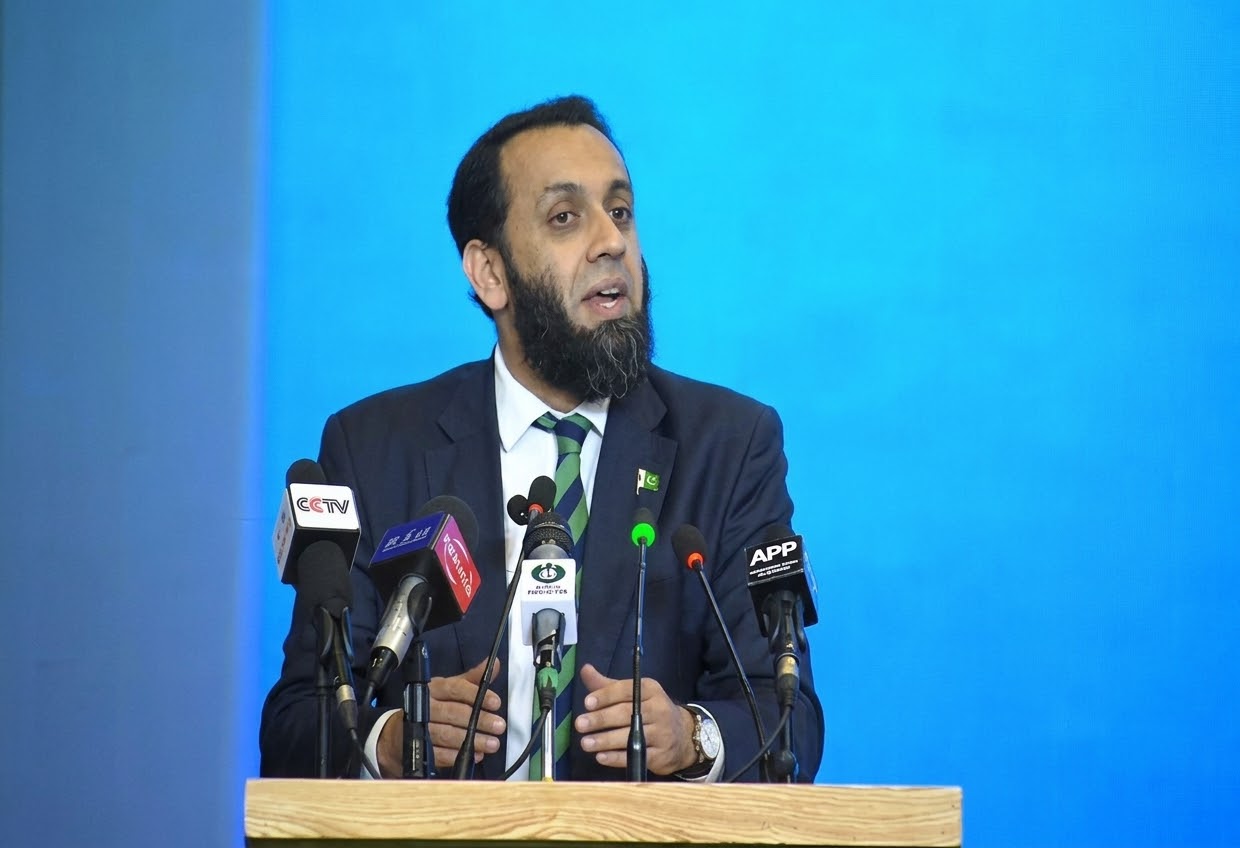
ISLAMABAD, Oct 27 (APP):Federal Minister for Information and Broadcasting Attaullah Tarar has said the China-Pakistan Information Corridor would deepen media cooperation, facilitate the exchange of verified news and strengthen people-to-people understanding between the two countries as they marked 75 years of diplomatic relations.
Addressing the launch ceremony of the China-Pakistan Information Corridor (CPIC), organised by the Ministry of Information and Broadcasting, the minister said the initiative would build on the longstanding relationship between Pakistan and China by extending cooperation beyond physical infrastructure to information sharing, digital platforms, research, business, culture and youth engagement.
He said the corridor was intended to connect the minds of the people of the two countries, complementing the physical connectivity established through the China-Pakistan Economic Corridor (CPEC).
“The first phase connected our lands; the next phase will connect our minds,” Atta Tarar said, describing the information corridor as a bridge between the people of Pakistan and China.
The minister said the initiative rested on four pillars: media; business and enterprise; think tanks; and culture, tourism and youth.
Under the media pillar, a news exchange working group comprising 18 Pakistani and Chinese media organisations was sharing verified news about bilateral cooperation. The participating organisations included state broadcasters, private television channels and Chinese media organisations such as Xinhua, China Media Group and People’s Daily, he said.
A dedicated fact-checking mechanism was also part of the initiative to track misleading narratives and respond to them with concrete facts, Atta Tarar added.
He said the corridor would use news exchanges, fact-checking mechanisms, trade portals, podcasts, social media channels and youth ambassadors to strengthen information sharing and public understanding.

Under the business and enterprise pillar, the initiative had opened its first regional office in Karachi and was developing a trade portal to track trade, investment and foreign direct investment, the minister said.
A podcast series was also being developed to tell the stories of Chinese entrepreneurs in Pakistan and Pakistani entrepreneurs in China, he added.
The think-tank pillar, led by the Pakistan-China Institute and involving leading research institutions, would promote joint dialogue, research and publications with Chinese counterparts.
Atta Tarar referred to Ambassador Khalid Mahmood, chairman of the Board of Governors of the Institute of Strategic Studies Islamabad, and said think tanks played an important role in shaping narratives.
The fourth pillar, covering culture, tourism and youth, was the heart of the corridor, he said.
Work was underway on a Xinjiang-Gilgit-Baltistan tourism corridor intended to extend the journeys of Chinese travellers into the valleys of northern Pakistan. A Pakistan-China friendship rally would also be held during the anniversary year.
The minister said the first cohort of CPEC youth ambassadors had been nominated from 13 universities across Pakistan, representing areas from Gilgit to Quetta, Peshawar to Karachi, and Muzaffarabad to Lahore.
He invited Chinese media organisations, think tanks, universities, enterprises and youth ambassadors to participate as full partners in each of the four pillars.
Recalling the development of bilateral ties, Atta Tarar said Pakistan and China shared not only a border but also rivers, mountains, cultures and traditions. He said the stories of their friendship had been passed down through generations.
He recounted that his mother, as a schoolgirl, had been among the children who welcomed Chinese Premier Zhou Enlai on the streets of Islamabad while holding a Chinese flag.
He also recalled that his grandfather, who was president of Pakistan in 1998, had welcomed Chinese Premier Zhu Rongji during a state visit to Pakistan.
The minister said these personal and historical accounts formed part of a shared inheritance that the two countries needed to carry forward to younger generations.
He described Pakistan-China friendship as distinctive, saying the word “Ba Tie” represented an iron-clad friendship in which the two countries regarded each other as iron brothers and sisters.
Atta Tarar said Chinese President Xi Jinping’s visit to Islamabad in 2015, at the invitation of then prime minister Nawaz Sharif, had given the relationship a new architecture through CPEC, the flagship project of China’s Belt and Road Initiative.
He said CPEC had brought electricity to homes that had previously remained without it, laid highways across Pakistan’s provinces and provided a gateway to the world through Gwadar.
The minister also highlighted the fiber-optic cable connecting Pakistan and China through the Khunjerab Pass, describing it as the first direct fiber-optic connection between the two countries.
He said the route crossed a region where the Hindu Kush, Himalayan and Karakoram mountain ranges met, linking Pakistan and China across the mountainous terrain.
Referring to the next phase of CPEC, Atta Tarar said Prime Minister Shehbaz Sharif and President Xi Jinping had set out a new horizon focused on growth, livelihoods, innovation, green development and openness.
He said the information corridor would complement this cooperation by connecting economies and strengthening mutual understanding.
The minister referred to President Xi’s vision of a community with a shared future for mankind, saying nations could not achieve lasting security through another country’s insecurity or lasting prosperity through another country’s poverty.
He said Pakistan had been among the first countries to embrace the vision and that the relationship between Pakistan and China had become a practical expression of it.
Atta Tarar said Prime Minister Shehbaz Sharif and President Xi Jinping had pledged to build a Pakistan-China community with a shared future in the new era.
He said the vision needed to take root in people’s minds before it could be built through physical infrastructure.
The minister also referred to President Xi’s Global Civilization Initiative, saying it called on countries to respect the diversity of civilizations and deepen people-to-people understanding through exchange and mutual learning.
He highlighted the role of digital cooperation in creating opportunities for Pakistan’s young population, saying more than 68 per cent of the country’s population was under 30.
He said the prime minister viewed the digital revolution as an opportunity for people, particularly young Pakistanis, and had pursued an agreement with Alibaba Group alongside scholarships for Pakistani information technology students to help them understand emerging trends.
Atta Tarar said the chairman of Alibaba Group drafted the memorandum of understanding using artificial intelligence at the prime minister’s insistence, and it was signed within 20 minutes during the visit. He said the agreement was being implemented.
The minister said China’s advances in the digital economy, including 5G, artificial intelligence, e-commerce and smart cities, represented major achievements of the modern era.
He said digital connectivity had become a source of power and that countries needed to communicate their own stories in the digital space.
“A nation that cannot tell its own story in the digital space will have its story told for it,” he said.
Atta Tarar said the information corridor would enable people in both countries to develop a better understanding of one another, with Pakistani students learning about contemporary China and Chinese families seeing Pakistan as a country that was warm, resilient and full of potential.
He said the initiative would respond to falsehoods with facts, isolation with exchange and suspicion with trust.
The minister said Pakistan-China cooperation was intended to advance the shared-future vision through practical collaboration across media, business, research, tourism, culture and youth.
Drawing a comparison with the Karakoram Highway, he said Pakistani and Chinese workers had built the road together through difficult mountainous terrain, with many losing their lives in the process.
He described the information corridor as a different kind of highway, built not of rock but of truth and carried not on trucks but through voices.
Atta Tarar said the initiative would carry the story of Pakistan-China friendship to homes in every language and help pass the relationship’s legacy to future generations.