
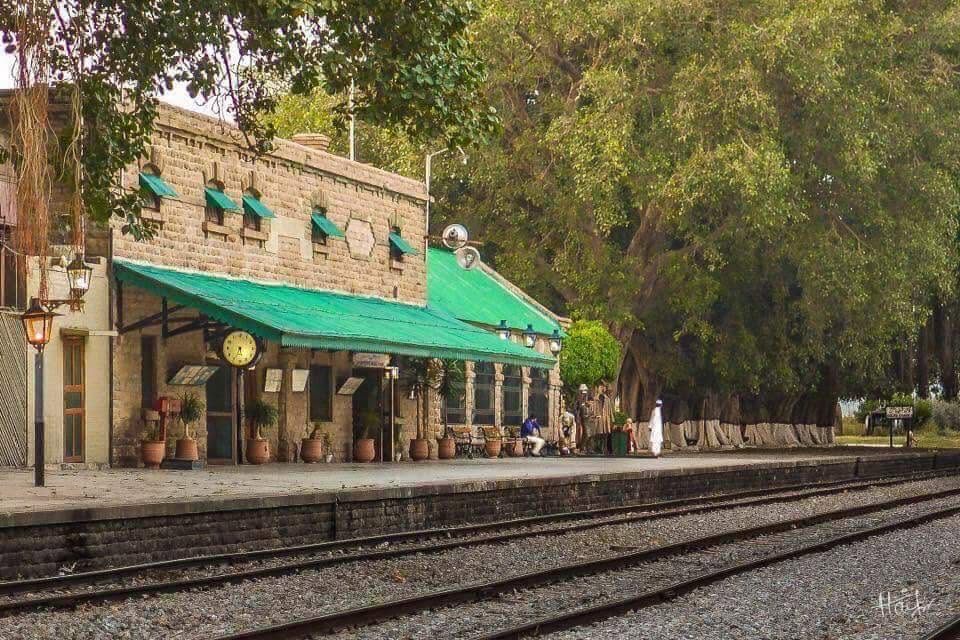
A family stood in the soft shade of towering banyan and peepal trees at the entrance of the Golra Sharif Railway Museum. The ancient trees spread their wide branches like a natural canopy, sheltering the historic site beneath them.
By Moniba Iftikhar
ISLAMABAD, Aug 20 (APP): A family stood in the soft shade of towering banyan and peepal trees at the entrance of the Golra Sharif Railway Museum. The ancient trees spread their wide branches like a natural canopy, sheltering the historic site beneath them. A light breeze moved through the leaves, creating a gentle rustling sound that seemed to whisper stories from the past. Sunlight filtered through the dense foliage in broken patterns, forming a shifting mosaic of gold and shadow across the ground.
For the visiting family, this calm and almost timeless environment immediately created a sense of wonder and anticipation. The children, in particular, looked around with wide, excited eyes, eager to explore what lay beyond the old iron gates of the museum.
Everything about the place from the quiet surroundings to the aged trees suggested that they were about to step into a different era.
As they entered the museum grounds, their excitement deepened. Around them stood rusted steam locomotives, vintage railway carriages, old mechanical signals and a variety of historical railway equipment. Each object seemed frozen in time, as if carefully placed to preserve memories of a long-gone age.
The children pointed enthusiastically at the massive engines, amazed by their size and structure, while their parents paused to admire the intricate craftsmanship of the machinery. The entire space felt like a gateway into a forgotten world where history still breathed through iron and wood.
Golra Railway Museum Curator Arsalan Shahid, who accompanied the visiting family, explained to APP that every item displayed in the museum carried its own story.
He emphasized that the museum was not merely a collection of outdated railway equipment but a living archive of Pakistan’s railway heritage. His words transformed the silent machines into symbols of human effort, journeys undertaken, and decades of technological change.
The museum itself was established in 2003 under the vision of Ishfaq Khattak, who was then the Divisional Superintendent of Rawalpindi. It was created with the purpose of preserving more than 150 years of railway history before it could fade away or be lost entirely.
Today, it stands as one of the few dedicated railway heritage institutions in the country, bringing together the technological, cultural, and social history of Pakistan Railways under one roof.
The family’s first stop was inside the two main galleries of the museum, where the story of railway development unfolded in detail. The first gallery focused on the technical and operational aspects of railway history. It displayed items dating back to the 19th century, showing how railway systems once functioned without modern digital technology.
Among the notable exhibits were Morse code telegraph machines that were once essential for communication between railway stations. There were also original rifles used by railway guards, tools for track maintenance and a KW Hour Meter manufactured by Ferranti of England.
A Western Electric control-room telephone from the United States further illustrated how communication once depended on wired systems and manual operation.
The children listened carefully as Arsalan Shahid explained how railway workers once relied entirely on mechanical systems, manual signals, and physical communication methods to ensure trains ran safely and on time. For them, raised in a digital world, these old technologies seemed almost unbelievable.
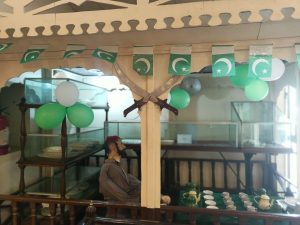
The second gallery offered a more cultural and social perspective on railway life. It displayed Victorian-style waiting room chairs, antique crockery used by railway officers at Mari Indus Station, and even a classic piano. These objects reflected a time when railway travel was not just about transportation but also a social experience filled with interaction and comfort.
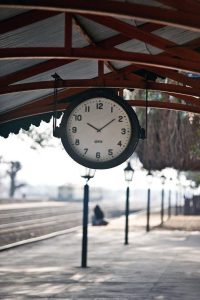
A collection of vintage clocks attracted special attention. Among them was a long-pendulum clock made by Gillett & Johnston of Croydon, London, in 1899. Surrounding it were various station clocks of different shapes and designs, all symbolizing the importance of punctuality in railway operations.
Another fascinating exhibit was a multilingual tea advertisement printed in English, Urdu, Hindi, Bengali and Gurmukhi. It included a tea recipe and information about its benefits, showing how railway networks once served as powerful channels of mass communication across the subcontinent.
The pre-partition section of the gallery created a more reflective atmosphere. Old photographs, official documents, and personal belongings transported visitors back to a time before the creation of Pakistan.
Among these were items associated with Quaid-e-Azam Muhammad Ali Jinnah, linking the railway system to key moments in the nation’s history.
Outside, the museum opened into a vast display of locomotives, carriages and railway equipment. Two historic saloons stood out prominently. Saloon No. 38, once used by the last Viceroy Lord Mountbatten and later by Quaid-e-Azam Muhammad Ali Jinnah, reflected the importance of rail travel for political and national leadership. Its polished teak wood interiors and elegant furnishings still carried the charm of a bygone era.
Another remarkable piece was Saloon No. 5, gifted by the Maharaja of Jodhpur to his daughter in 1888. Built at the Ajmer Sharif Carriage Workshop, it featured detailed wood carvings and royal interiors, offering visitors a glimpse into the luxurious travel of royal families.
Nearby stood Canadian Locomotive 5734, a massive engine that immediately captured the children’ s imagination. Manufactured by the Canadian Locomotive Company and given to Indian State Railways in 1945 as part of post-World War II assistance, it represented international cooperation in railway development.
Relief Bogie 1391, built in 1930 by Metropolitan Cammell of Birmingham, was another important exhibit. It was originally used for transporting coal, salt, and stone on the Mari Indus–Bannu–Tank route before being converted for accident-relief operations. The Hand-Turned Pump, made by R. Warner & Co. of London in 1904, highlighted the essential tools once used to supply water to steam engines.
A narrow-gauge steam locomotive from over a century ago stood beside a modern diesel engine, creating a powerful contrast between two technological eras one driven by steam and manual effort, the other by modern engineering and efficiency.
Speaking to the APP, Arsalan Shahid explained that the museum remains open seven days a week for both local and international visitors.
He said its purpose goes beyond displaying artifacts; it preserves the complete evolution of Pakistan Railways, including its mechanical systems, communication methods and operational history.
He said its purpose goes beyond displaying artifacts; it preserves the complete evolution of Pakistan Railways, including its mechanical systems, communication methods and operational history.
In every wheel, whistle and weathered piece of machinery, the museum keeps alive the echoes of journeys that shaped generations.
As the trains of the past slowly fade into history, their stories remain on the tracks of memory reminding us that when the wheels stop turning, history does not; it simply waits to be heard again.